|
 |
CORNEILLE (Belgium, Liège 1922 - Auvers-sur-Oise 2010)
DANGELO Sergio (Italy, Milan 1932 - Milan 2022)
GÖTZ Karl Otto (Germany, Aachen 1914 - Wolfenacker 2017)
HANTAÏ Simon (Hungary, Bia 1922 - Paris 2008)
IKEDA Tatsuo (Japan, Saga 1928 - Tokyo 2020)
JAGUER Édouard (France, Paris 1924-2006)
KANTOR Tadeusz (Poland, 1915 - Kraków 1990)
LLINÁS Julio (Argentina, Buenos Aires 1929-2018) |
NOUGÉ Paul (Belgium, Brussels 1895 - Brussels Region 1967)
PARENT Mimi (Canada, Montreal 1924 - Villars-sur-Ollon 2005)
PEDERSEN Carl-Henning (Denmark, Copenhagen 1913-2007)
REIGL Judit (Hungary, Kapuvár 1923 - Marcoussis 2020)
SNAITH Stanley (United Kingdom, Kendal 1903 - London 1976)
TÉLÉMAQUE Hervé (Haiti, Port-au-Prince 1937 - Ivry-sur-Seine 2022)
VAN DE LOO Otto (Germany, Essen 1924 - Munich 2015)
etc...
|
|
| |
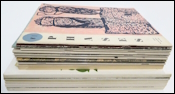
[COLLECTIF]
Collection Phases
Paris, Phases, 1954-1975. |
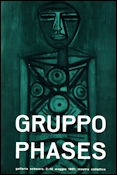
[COLLECTIF]
Gruppo Phases
Milano, Galleria Schwarz, 1961. |
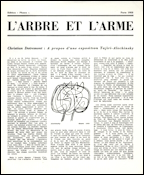
[COLLECTIF]
L'Arbre et l'Arme
Amsterdam, Cahiers Phases, 1953. |
|
|
| |
|
|
|
| |
|
|
| |
|



The PHASES movement was officially born in 1954 in Paris under the impetus of Édouard Jaguer, who launched the eponymous journal to extend the spirit of revolt found in previous short-lived publications such as Révolution la Nuit (1946) or Les Deux Sœurs. Conceived from the outset as an international network rather than a rigid school, the movement positioned itself at the crossroads of Surrealism (from which Jaguer temporarily distanced himself by rejecting André Breton's dogmatism) and Lyrical Abstraction. Since its foundation, the goal was to create a space of convergence for the global poetic and plastic avant-gardes, asserting total freedom against the academicism and the art market of the post-war era.
The movement's growth materialized through an incredible editorial momentum and a series of major exhibitions across Europe and the Americas throughout the 1950s and 1960s. The first major public confrontation took place as early as 1955 at the Galerie Kléber in Paris, followed by historical milestones abroad, notably the traveling exhibition in Poland in 1959 or the one in Buenos Aires in the early 1960s, which sealed deep connections with the Argentine group Boa. Thanks to these international ramifications, the Phases journal published issues of great typographical and visual richness, blending theoretical texts, automatic poetry, and reproductions of artworks, becoming the main link between previously isolated artistic hubs.
On the aesthetic and theoretical level, the movement rejected the watertight border between abstract and figurative art, preferring to explore the concept of the analogical image and "magical morphology." Édouard Jaguer championed techniques rooted in automatism, chance, and textural experimentation, welcoming creators into the movement who utilized frottage, collage, dripping, or decalcomania. PHASES thus became a welcoming platform for many major artists emerging from CoBrA (such as ALECHINSKY or CORNEILLE), Italian Spatialism, or the Informal Art movement, all united by the desire to reveal the poetic power and hidden dreamscapes at the heart of pictorial matter.
The longevity of PHASES was exceptional for an avant-garde movement, as its collective activities and publications continued actively until the early 2000s, the year of Édouard Jaguer's passing. Over the decades, the movement established a lasting rapprochement with the official Surrealist group starting in 1959, while maintaining its autonomy and its role as a discoverer of talent. Today, the history of PHASES is recognized for having preserved the flame of international poetic experimentation, connecting artists of all nationalities around a shared ideal of absolute creative freedom.
A few of the most significant historical exhibitions that marked and structured the international journey of the movement:
- « Phases » (1955 – Galerie Kléber, Paris)
This was the very first official collective exhibition of the movement in France, organized right after the launch of the journal. Édouard Jaguer laid down the visual foundations of the burgeoning network, bringing together works that fused the Surrealist spirit with the explorations of Lyrical Abstraction.
- « Phasen » (1957 – Galerie van de Loo, Munich)
This milestone marked the expansion of Phases into Germany. It enabled the establishment of close ties with avant-garde artists across the Rhine, notably members of the Spur group, and affirmed the European and cross-border dimension of the movement.
- « Phases – Confrontation internationale » (1959 – National Museum, Poznan / Lódz, Poland)
A major historical and political milestone. In the midst of the Cold War, Jaguer succeeded in organizing an official exhibition in Poland, creating a unique cultural bridge between Western artists and the Polish avant-garde (around figures like Kantor). The impact on the local art scene was immense.
- « Phases – International Exhibition » (1960 – Galerie Van Lier, Amsterdam)
Organized in the Netherlands, this exhibition followed in the direct path of the networks woven during the CoBrA era. It confirmed the anchoring of Phases in Northern European countries and its capacity to unite creators advocating for a spontaneous and texture-driven painting style.
- « Phases – First River Exhibition » (1963 – Museo de Artes Plásticas, Buenos Aires, Argentina)
This exhibition sealed the definitive alliance between the Parisian core of PHASES and the Argentine group Boa, led by Julio Llinás. It marked the pinnacle of the movement's expansion into the South American continent, where poetic automatism found a vibrant echo.
- « Phases » (1972 – Musée des Beaux-Arts, Mons, Belgium)
A major retrospective that reviewed nearly two decades of activities, publications, and artistic complicities, particularly with Belgian Surrealism, reaffirming the longevity and theoretical consistency of Édouard Jaguer's movement.
- « Phases » (1974 – Musée d'Ixelles, Brussels, Belgium)
An immense collective confrontation that came to seal the unbreakable bonds between the French pole of PHASES and Belgium (a historical breeding ground that had already embraced the spirit of CoBrA and Surrealism).
- « 1ª exposição Phases em Portugal » (1977-1978 – Estoril, Porto, Coimbra, Portugal)
Following the fall of the dictatorship in Portugal (the Carnation Revolution in 1974), the PHASES movement carried out a major traveling tour there to connect artists of the Portuguese cultural liberation with international Surrealism. The reception would extend to the Société Nationale des Beaux-Arts in Lisbonne in 1979 and 1985.
- « Phases » (1978 – Museo Carrillo Gil, Mexico City, Mexico)
A large-scale deployment on the American continent, where the movement exhibited its concepts of automatism and magical morphology within Mexican artistic circles.
- « Métamorphases » (1991 – Galerie 13, Hannover, Germany)
A major German thematic exhibition celebrating the permanence of the experimental techniques (collages, transformations of matter) championed by the movement.
- « Phases, from 1952 to the horizon 2001 » (2000 – Centre culturel Le Kiosque, Mayenne and Centre culturel Noroît, Arras, France)
One of the very last large-scale manifestations held during Édouard Jaguer's lifetime. Conceived as a retrospective and prospective overview at the turn of the millennium, it traced nearly 50 years of artistic insubordination.