 themes : LYRICAL ABSTRACTION themes : LYRICAL ABSTRACTION
|
 |
ATLAN Jean-Michel (Algérie, Constantine 1913 - Paris 1960)
BARRÉ Martin (France, Nantes 1924 - Paris 1993)
BITRAN Albert (Turquie, Istanbul 1931 - Villejuif 2020)
BRYEN Camille (France, Nantes 1907 - Paris 1977)
DEGOTTEX Jean (France, Sathonay-Camp 1918 - Paris 1988)
DOUCET Jacques (France, Boulogne-Billancourt 1924 - Paris 1994)
DUMITRESCO Natalia (Roumanie, Bucarest 1915 - Chars 1997)
FAUTRIER Jean (France, Paris 1898 - Châtenay-Malabry 1964)
FICHET Pierre (France, Paris 1927-2007)
GAUTHIER Oscar (France, Fours 1921 - Boulogne-Billancourt 2009)
GERMAIN Jacques (France, Paris 1915-2001)
GUITET James (France, Nantes 1925 - Biarritz 2010)
HANTAÏ Simon (Hongrie, Bia 1922 - Paris 2008)
HARTUNG Hans (Allemagne, Leipzig 1904 - Antibes 1989)
ISTRATI Alexandre (Roumanie, Dorohoi 1915 - Paris 1991)
|
LAGAGE Pierre-César (France, Montrouge 1911 - Seillans 1977)
LAUBIÈS René (Tunisie, La Goulette 1922 - Mangalore 2006)
MANESSIER Alfred (France, Saint-Ouen 1911 - Orléans 1993)
MATHIEU Georges (France, Boulogne/Mer 1921 - B.-Billancourt 2012)
MICHAUX Henri (Belgique, Namur 1899 - Paris 1984)
RAYMOND Marie (France, La Colle-sur-Loup 1908 - Paris 1989)
RIOPELLE Jean-Paul (Canada, Montréal 1923 - L'Isle-aux-Grues 2002)
SCHNEIDER Gérard (Suisse, Sainte-Croix 1896 - Paris 1986)
SIMA Joseph (République tchèque, Jaromer 1891 - Paris 1971)
SINGIER Gustave (Belgique, Warneton 1909 - Paris 1984)
SUGAÏ Kumi (Japon, Kobe 1919 - Kobe 1996)
WOLS (Allemagne, Berlin 1913 - Paris 1951)
ZACK Léon (Russie, Nijni Novgorod 1892 - Vanves 1980)
ZAO Wou-Ki (Chine, Pékin 1920 - Nyon 2013)
etc...
|
|
| |
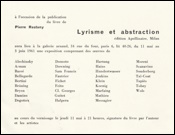
[COLLECTIF].
Lyrisme et Abstraction.
Paris, Galerie Arnaud, 1961. |
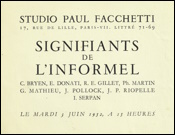
[COLLECTIF]
Signifiants de l'informel
Paris, Studio Paul Facchetti, 1952. |
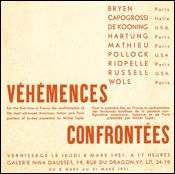
[COLLECTIF]
Véhémences confrontées
Paris, Galerie Nina Dausset, 1951. |
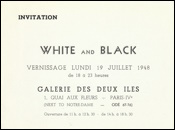
[COLLECTIF].
White and Black.
Paris, La Galerie des Deux-Iles, 1948. |
|
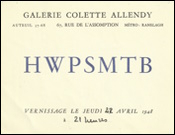
[COLLECTIF].
HWPSMTB.
Paris, Galerie Colette Allendy, 1948. |
|
|
|
|
| |
|
"[...] It was before 1950, during those feverish years that followed the Liberation of Paris, that an absolutely new art appeared, naturally embodying itself in a lyrical flight. Polysemic controversies between abstraction and figuration dominated the aesthetic debates at the time. And even within abstract art, disputes were sharp between geometric abstraction artists and those of what would soon be called lyrical abstraction.
As surprising as it may seem today, geometric abstraction predominated during the first post-war years.
[...] One might have believed that, faced with the counter-offensive of figurative painting [...], there would be no other way than a return to tradition or the negation of any figure.
Yet, another path was appearing, still underground, completely marginal, and one that very few art lovers discerned. Undoubtedly, the exhibition that the René Drouin gallery, Place Vendôme, dedicated to that unknown figure WOLS was decisive, since it sparked, in the summer of 1947, the enthusiasm of a young painter, Georges MATHIEU, whose action was going to be critical for this lyrical flight. [...]
To validate a trend, a group exhibition and a manifesto are required. The very young and then-unknown MATHIEU (he was twenty-six years old) assumed this role. In December 1947, he organized an exhibition at the Galerie du Luxembourg for which he wanted to give the title Towards Lyrical Abstraction. The gallery preferred L'imaginaire. But the movement was launched.
The following year, the Colette Allendy gallery asked him to organize a new exhibition on the same theme titled H W P S M T B, the first letters of each exhibitor's name: HARTUNG, WOLS, PICABIA, STAHLY, MATHIEU, TAPIÉ, BRYEN.
The abandonment of traditional figuration, the rejection of rules, and notably those of geometry and flat-color painting, along with a lyrical flight—these were the criteria of the new painting. Mathieu added speed and improvisation to them. [...]"
Michel Ragon, L'envolée lyrique Paris 1945-1956, Paris, Musée du Luxembourg, 2006, pp. 19-20 |
| |
|


Lyrical Abstraction refers to an artistic movement born in Paris in the aftermath of World War II, around 1947, as a reaction against the rigidity of geometric abstraction and Surrealism. Championed by the critic Jean José Marchand and the painter Georges MATHIEU, this movement favored the direct expression of emotion, improvisation, and freedom of gesture. Contrary to cold and calculated abstraction, lyrical abstraction placed the artist's temperament at the core of the work, making the canvas a seismograph of their states of mind and spontaneity.
The movement organized itself around seminal exhibitions, notably the one entitled “L'imaginaire” at the Galerie du Luxembourg in 1947, which brought together key figures such as Hans HARTUNG, WOLS, Georges MATHIEU, and Camille BRYEN. These artists explored new techniques such as paint throwing, scraping, or Tachism. The career of Georges MATHIEU is particularly emblematic: he transformed the act of painting into a true public performance, using speed as a way to bypass rational thought and unleash vital energy.
On the international stage, French Lyrical Abstraction resonated (and sometimes competed) with American Abstract Expressionism led by Jackson POLLOCK. While the New York School favored monumental formats and the "all-over" technique, European lyrical artists often maintained a more nuanced sensitivity, inherited from the pictorial tradition of the Old Continent. Artists like Pierre SOULAGES (in his early years) or Jean-Paul RIOPELLE took part in this creative effervescence, exhibiting in major world capitals and asserting the dominance of the Parisian scene during the 1950s.
The historical recognition of this movement was confirmed through major events, such as the grand exhibition “L'Envolée lyrique” at the Musée du Luxembourg in 2006, which retraced the history of this trend between 1945 and 1956. Although the movement lost its momentum with the arrival of Nouveau Réalisme and Pop Art in the 1960s, its legacy remains immense. It paved the way for radical subjectivity in abstract art, lastingly influencing future generations in their relationship to matter, sign, and the liberated gesture.
A selection of major historical exhibitions that jalonned, structured, and defined the history of Lyrical Abstraction, in France and internationally:
- “Véhémences confrontées” (March 1951 – Galerie Nina Dausset, Paris)
Driven by critic Michel Tapié and Georges Mathieu, this international exhibition marked a turning point. For the first time, it confronted the leaders of the Parisian avant-garde (Wols, Bryen, Mathieu) with the figureheads of American Abstract Expressionism (Jackson Pollock, Willem de Kooning). The exhibition laid the theoretical foundations of what Tapié would term “Art Autre” (Art of Another Kind) or “informal art”.
“Signifiants de l'Informel” (Studio Facchetti, Paris, 1952)
Organized once again by Michel Tapié, this exhibition definitively anchored the lyrical and informal vocabulary in Paris. It highlighted major artists such as Jean Fautrier, Jean Dubuffet, Michaux, Riopelle, and Sam Francis, popularizing the concept of painting freed from traditional compositional structures.
“Dawn of the New Movement” (1955 – Tokyo, Japan)
Lyrical Abstraction rapidly expanded internationally, notably to Japan thanks to the travels and lectures of Georges Mathieu and Michel Tapié. This exhibition, along with the live, large-scale painting performances conducted on-site, sealed deep connections between Western Lyrical Abstraction and the Japanese avant-garde movement Gutai (led by Jiro Yoshihara).
“L'Abstraction Lyrique aux États-Unis” (1970 – Whitney Museum of American Art, New York)
Although the term was coined in France in the late 1940s, a second artistic wave explicitly claimed the label of “Lyrical Abstraction” in the United States during the late 1960s. This traveling institutional exhibition highlighted a reaction against rigid Minimalism and Pop Art, promoting young American artists (such as Dan Christensen, Ronnie Landfield, or Pat Lipsky) who adopted a more fluid, free, and sensory pictorial approach.
“L'Envolée Lyrique, Paris 1945-1956” (2006 – Musée du Luxembourg, Paris)
Designed specifically to retrace the golden decade of the movement, this exhibition gathered the historical core of Lyrical Abstraction (featuring major works by Atlan, Barré, Degottex, Hartung, Mathieu, Riopelle, Schneider, Soulages, and Vieira da Silva). It allowed for a rediscovery of the freshness, the violence of gesture, and the poetry of these years of total freedom.
“Le Geste et la Matière. Une abstraction autre (Paris, 1945-1960)” (2017 – Fondation Clément, Martinique)
A major exhibition (organized in partnership with the Centre Pompidou) that demonstrated how Lyrical Abstraction and informal art represented a universal liberation of form, finding an echo far beyond European or American borders.
“Action, Gesture, Paint: Women in Abstraction 1940–1970” (2023 – Whitechapel Gallery, London / Fondation Van Gogh, Arles)
A major and recent international exhibition that completely renewed the history of the movement by bringing to light the crucial — and often historically underestimated — role of women artists in global Lyrical Abstraction and Abstract Expressionism (such as Marie Raymond, Judit Reigl, Natalia Dumitresco, Helen Frankenthaler, or Lee Krasner).