 themes : CONCEPTUAL ART themes : CONCEPTUAL ART
|
 |
ACCONCI Vito (United States, New York 1940-2017)
ART & LANGUAGE (British collective, founded in 1968)
BALDESSARI John (United States, 1931 - Los Angeles 2020)
BARRY Robert (United States, New York 1936)
BEUYS Joseph (Germany, Krefeld 1921 - Düsseldorf 1986)
BROODTHAERS Marcel (Belgium, 1924 - Germany, 1976)
BUREN Daniel (France, Boulogne-Billancourt 1938)
DARBOVEN Hanne (Germany, Munich 1941 - Hambourg 2009)
DIBBETS Jan (Netherlands, Weert 1941)
HAACKE Hans (Germany, Cologne 1936) |
HUEBLER Douglas (United States, Ann Arbor 1924 - Cape Cod 1997)
KAWARA On (Japan, 1932 - United States, 2014)
KOSUTH Joseph (United States, Toledo 1945)
LEWITT Sol (United States, Hartford 1928 - New York 2007)
MORRIS Robert (United States, 1931 - Kingston 2018)
ONO Yoko (Japan, Tokyo 1933)
RUSCHA Edward (Ed) (United States, Omaha 1937)
VENET Bernar (France, Château-Arnoux-Saint-Auban 1941)
WEINER Lawrence (United States, New York 1942 - 2021)
etc...
|
|
| |
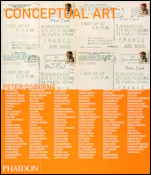
[CONCEPTUAL ART].
Conceptual Art.
London, Phaidon Press, 2002. |
[CONCEPTUAL ART].
Conceptual Art, A Perspective.
Paris, Musée d'art moderne, 1989. |
[CONCEPTUAL ART].
Conceptual Art.
New York, E.P. Dutton, 1972. |
[COLLECTIVE] - Germano Celant.
Conceptual art - Arte povera - Land art.
Torino, Galleria Civica, 1970. |
|
| |
|
|
|
| |
|


CONCEPTUAL ART is a major avant-garde movement that appeared in the mid-1960s, radically overturning traditional aesthetic criteria. Its fundamental characteristic is to prioritize the idea, the concept, or the process of the work rather than its material execution or final form. By asserting that the art object is no longer an end in itself, artists like Sol LEWITT redefined creation: the theoretical project or the written protocol becomes the true artwork, while material execution is relegated to the background.
This dematerialization of art pushed creators to adopt new mediums, foremost among which are language and text. Artists like Lawrence WEINER or the collective ART & LANGUAGE replaced paintings with textual statements or logical propositions. Joseph KOSUTH, through his famous installations combining real objects, photographs, and dictionary definitions, engaged in a tautological reflection where art is no longer a representation of the world, but an analysis of its own language and its own definition.
Time, measurement, and the archiving of daily life also became major axes of exploration for this movement. On KAWARA thus dedicated a large part of his life to meticulously painting the current date on monochrome canvases, thereby archiving the passage of time in an almost ritualistic manner. In a similar spirit, Hanne DARBOVEN translated history and temporal structures through series of numerical calculations and calendars, while Vito ACCONCI or Yoko ONO used strict lists of instructions to involve the body or the spectator in a defined space-time.
The movement structured and spread very rapidly on an international scale thanks to manifesto exhibitions and visionary curators. The exhibition organized by Seth Siegelaub in New York in 1969, where the textual catalogue constituted the main work, or the mythical exhibition by Harald Szeemann in Bern the same year bringing together Robert MORRIS and Jan DIBBETS, officialized this transition. By shifting art from the domain of strict visual perception to that of the intellect, CONCEPTUAL ART paved the way for almost all contemporary artistic practices.
Here is a selection of the major thematic and retrospective exhibitions that, from the 1960s to the present day, have documented, reassessed, and celebrated the ongoing impact of Conceptual Art:
- « Primary Structures » (April – May 1966, Jewish Museum, New York)
Although often linked to the birth of Minimalism, this exhibition is the first indispensable milestone toward Conceptual Art. By bringing together geometric and refined structures by artists like Sol LEWITT or Robert MORRIS, it radically shifted the public's interest: the work was no longer judged by the craftsmanship of the artist's hand, but by the logical system and the idea that guided its making. It opened the way wide to the dematerialization of the art object.
- « Non-Anthropomorphic Art » (June 1967, L'Attico Gallery, Rome)
This exhibition marked the immediate and international emergence of conceptual reflection in Europe. It staged the refusal of the human figure and traditional expressionism. Artists like Joseph KOSUTH asserted a desire to break away from pictorial illusionism to move toward purely intellectual propositions, where art becomes an inquiry into its own nature and its own language.
- « January 5-31, 1969 » (January 1969, New York)
Organized by the legendary curator Seth Siegelaub, this event is considered the official birth certificate of the movement in its most radical form. The exhibition had no fixed physical location and was almost entirely reduced to its printed catalogue. The works of Robert BARRY, Joseph KOSUTH, or Lawrence WEINER existed as textual statements, proving that the idea and the printed information were sufficient to make a work, without the need for a material support.
- « When Attitudes Become Form » (March – April 1969, Kunsthalle Bern, Switzerland)
Orchestrated by Harald Szeemann, this historic exhibition (exactly titled Live in Your Head: When Attitudes Become Form) was the first major international confrontation of the avant-gardes. It brought together American and European Conceptual Art, Minimalism, and Arte Povera. By inviting artists like Hanne DARBOVEN, Jan DIBBETS, Sol LEWITT, or Lawrence WEINER to occupy the museum not to hang finished works but to materialize mental processes, Szeemann sacralized attitude and concept as the supreme artistic forms of the era.
- « Information » (July – September 1970, Museum of Modern Art, New York)
Organized by Kynaston McShine, this international exhibition captured Conceptual Art at the precise moment it became a global phenomenon. It brought together artists like Vito ACCONCI, John BALDESSARI, Hans HAACKE, or Yoko ONO. MoMA was transformed into a communication center where the works took the form of telegrams, photocopied documents, surveys, or magnetic tapes, officializing the use of information technologies as an artistic medium.
- « Conceptual Art, a Perspective » (November 1989 – February 1990, Musée d'Art Moderne de la Ville de Paris)
This historic exhibition, conceived by Claude Gintz, constituted the first major European institutional attempt to establish a critical and historical assessment of the first wave of the movement (1965-1975). It allowed for a renewed confrontation of the foundational works of ART & LANGUAGE, Robert BARRY, Joseph KOSUTH, Sol LEWITT, and Lawrence WEINER, definitively anchoring Conceptual Art in the official history of 20th-century art.
- « Global Conceptualism: Points of Origin, 1950s–1980s » (April – August 1999, Queens Museum, New York)
This fundamental traveling exhibition revolutionized the approach to the movement by demonstrating that Conceptual Art was not merely an American-European invention. By widening the geographical research (Latin America, Eastern Europe, Asia, Africa), it proved that artists from all over the world, like On KAWARA in Japan or collectives politically engaged under dictatorships, independently used dematerialization and language as a tool of political resistance and freedom of expression.
- « Less Visual, More Conceptual » (2012, Museu d'Art Contemporani de Barcelona, Spain)
Centered on the permanent collection of the MACBA, this exhibition highlighted the persistence and reactivation of conceptual strategies among contemporary artists. It explored how textual protocols, institutional critique, and the use of the document initiated by the first generation continue to feed current creation, particularly through issues related to globalization and the digitization of data.
- « Conceptual Art in Britain 1964–1979 » (April – August 2016, Tate Britain, London)
This major national retrospective examined the British specificity of the movement during a period of profound political and economic upheavals. By placing the ART & LANGUAGE collective at the center of the exhibition layout, it showed how these artists used language and critical analysis to attack the traditional art market and redefine the social role of the artist in modern society.