 themes : COBRA (COpenhagen BRussels Amsterdam)
1948 - 1951. themes : COBRA (COpenhagen BRussels Amsterdam)
1948 - 1951.
|
 |
Pierre ALECHINSKY (Belgium, Brussels 1927)
Else ALFELT (Denmark, Copenhagen 1910 - 1974)
Karel APPEL (Netherlands, Amsterdam 1921 - Zurich 2006)
Jean-Michel ATLAN (Algeria, Constantine 1913 - Paris 1960)
Ejler BILLE (Denmark, Odder 1910 - Ørby 2004)
Eugène BRANDS (Netherlands, Amsterdam 1913 - Amsterdam 2002)
Hugo CLAUS (Belgium, Bruges 1929 - Antwerp 2008)
CONSTANT (Netherlands, Amsterdam 1920 - Utrecht 2005)
CORNEILLE (Belgium, Liège 1922 - Auvers-sur-Oise 2010)
Christian DOTREMONT (Belgium, Tervuren 1922 - Buizingen 1979)
Jaques DOUCET (France, Boulogne-Billancourt 1924 - Paris 1994)
Sonja FERLOV MANCOBA (Denmark, 1911 - France 1984)
Henry HEERUP (Denmark, Copenhagen 1907-1993)
|
Egill JACOBSEN (Denmark, Copenhagen 1910 - Copenhagen 1998)
Asger JORN (Denmark, Vejrum 1914 - Aarhus 1973)
LUCEBERT (Netherlands, Amsterdam 1924 - Alkmaar 1994)
Ernest MANCOBA (South Africa, Johannesburg 1904 - Paris 2002)
Joseph NOIRET (Belgium, Brussels 1927 - Brussels 2012)
Carl-Henning PEDERSEN (Denmark, Copenhagen 1913- 2007)
Jean RAINE (Jean GEENEN) (Belgium, 1927 - France 1986)
REINHOUD (d'HAESE) (Belgium, 1928 - France 2007)
Anton ROOSKENS (Netherlands, Griendtsveen 1906 - Amsterdam 1976)
Shinkichi TAJIRI (United States, 1923 - Netherlands, 2009)
Raoul UBAC (Belgium, Malmedy 1910 - Dieudonné 1985)
Serge VANDERCAM (Denmark, 1924 - Belgium, 2005)
Theo WOLVECAMP (Netherlands, Hengelo 1925 - Amsterdam 1992)
|
|
| |
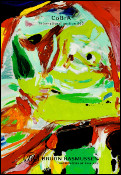
[COBRA]
COBRA
Copenhague, Bruun Rasmussen, 2016. |
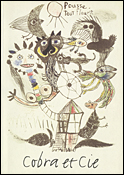
[COLLECTIF]
COBRA et Cie
La Louvière, Centre de la Gravure, 2004. |
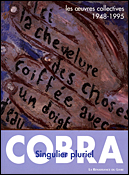
[COBRA]
COBRA | Singulier pluriel
Belgique, La Renaissance du Livre, 1998. |
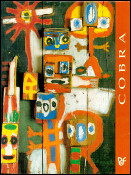
[COBRA]
COBRA
Paris, Nouvelle Édition Française, 1994. |
|
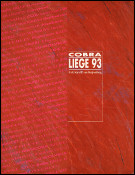
[COBRA]
COBRA revisité | Liège 93
Liège, Musée d'Art Moderne, 1993. |
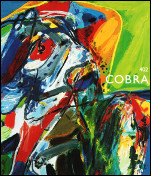
[COBRA]
COBRA
Copenhague, Kunsthallen, 1991. |
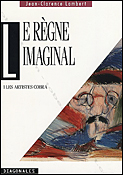
[COBRA]
Le règne imaginal
Barcelone, Cercle d'Art, 1991. |
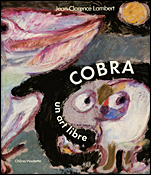
[COLLECTIF]
COBRA un art libre
Paris, Éditions du Chêne, 1983. |
|
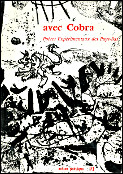
[COBRA]
Avec Cobra
Nîmes, Action Poétique, 1983. |
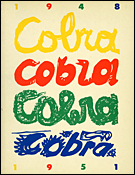
[COBRA]
COBRA 1948-1951
Paris, Musée d'Art Moderne, 1982. |
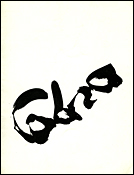
alt="COBRA (1948-1951)"
[COBRA]
COBRA
Den Haag, Galerie Nova Spectra, 1981. |
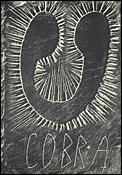
[COBRA]
COBRA et après...
Bruxelles, Galerie Aujourd'hui, 1962. |
|
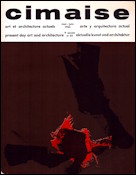
[COLLECTIF]
Cimaise N°59
Paris, Cimaise, 1962. |
[COLLECTIF]
Cobra dix ans après
Paris, Galerie Mathias Fels, 1961. |
[COLLECTIF]
CERAMICHE
Decima Triennale di Milano, 1954. |
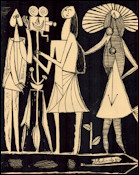
[Pierre ALECHINSKY]
Bulletin COBRA N°3
Bruxelles, Cobra / Dotremont, 1949. |
|
| |
|
|
|
| |
|
"In early November 1948, at the Maison des Lettres, rue Férou, in Paris, the Conference of the International Documentation Center on Avant-Garde Art is organized. The ultimate meeting within Revolutionary Surrealism, between representatives of different countries and a French surrealism that is outdated, yet still alive. This meeting ends in failure.
At the Hôtel Le Notre Dame, around a café table, Christian Dotremont and Joseph Noiret, members of the Belgian Revolutionary Center, Asger Jorn, from the Danish Experimental Group, and Appel, Constant, Corneille, from the Dutch Experimental Group, draw up the report of this failure." (1)
"A railway story"? Christian Dotremont gave many other definitions of Cobra. On November 8, 1978, exactly thirty years to the day after the memorable meeting at the café Notre-Dame in Paris, where Cobra was formed, he wrote, in one of those sovereign litotes he was fond of: "Cobra is a movement that was slightly organized for three years." For us, it goes without saying that if, like so many other gatherings of artists and poets, Cobra had indeed ceased to exist by becoming disorganized, people would hardly speak of it anymore. There would remain ten issues of a so-called avant-garde magazine, which never had an easy life, a few other publications printed in very small numbers, and the memory of exhibitions prepared under conditions that were precarious every time... Yet Cobra has gained growing importance over the years, even though the events that marked its brief existence left few traces at the time. Clearly, Cobra is much more than Cobra, than the historical Cobra. It cannot be enclosed within the narrow limits of its brief chronology. There is a spirit, a Cobra art, which never ceased to be productive after the gathering became disorganized. The movement's leaders continued on their momentum and developed, with more or less divergence from the general line, what they had initiated as early as 1948-1951. By establishing themselves among the most important creators of the second half of the 20th century, they made Cobra art one of the essential components of our sensibility. And nothing is static.(2)
Excerpts from:
(1) "Cobra", by Richard Miller (© 1994 - Nlles Editions Françaises)
(2) "Cobra un art libre", by Jean-Clarence Lambert (© 1983 - Sté Nlle des Editions du Chêne, Paris and Fonds Mercator, Antwerp). |
| |
|


The CoBrA movement was officially born on November 8, 1948, in Paris, at the café of the Hôtel Notre-Dame. Its name is an acronym coined by the poet Christian DOTREMONT from the first letters of the home cities of its founding members: Copenhagen, Brussels, and Amsterdam. Breaking completely away from French surrealism, which they deemed dogmatic and outdated, as well as from the austerity of geometric abstraction, these artists and writers united to demand absolute creative freedom, guided by spontaneity and collective experimentation.
The aesthetics of CoBrA are characterized by an expressionist fury of painting, the use of bright and saturated colors, and a wild gestural approach. The group's artists, including Asger JORN, Karel APPEL, CORNEILLE, Pierre ALECHINSKY, and Jean-Michel ATLAN, rejected traditional Western aesthetic canons. They drew inspiration from primitive art, folk art, children's drawings, Nordic myths, and the art of the mentally ill, seeking to rediscover a pure form of creativity, free from any intellectual or bourgeois censorship.
Despite a prolific artistic and literary production, the group's formal existence was particularly brief. The collective adventure officially ended in 1951, marked by severe internal dissensions, chronic financial difficulties in sustaining their self-titled journal, as well as the illness of two of its main pillars, Christian DOTREMONT and Asger JORN. In just three years, the movement nevertheless succeeded in shaking up the post-war European artistic landscape through landmark exhibitions, notably the one in Amsterdam in 1949 and the one in Liège in 1951.
Although dissolved in the early 1950s, the legacy of CoBrA remains immense in the history of contemporary art of the second half of the 20th century. By merging abstraction and figuration within a visceral and spontaneous approach, its members laid the foundations for European abstract expressionism and Art Informel. The libertarian and experimental spirit of CoBrA would continue to feed into the individual work of its creators throughout their careers, durably marking the modern artistic sensibility.
A few key exhibitions that punctuate the group's history:
- « L'Art Abstrait » (November 1948, Tokanten Gallery, Copenhagen)
Organized parallel to the official creation of the group in Paris, this exhibition by the Danish group Høst constitutes the first public and collective appearance of the founding artists of CoBrA, mixing the works of Asger JORN, Carl-Henning PEDERSEN, and their Dutch comrades.
- « Exposition Internationale d'Art Experimental » (November 1949, Stedelijk Museum, Amsterdam)
This was the first major official exhibition under the name CoBrA. Orchestrated by the museum's director Willem Sandberg and designed by architect Aldo van Eyck, it caused a scandal with its revolutionary layout and the chromatic violence of the works of Karel APPEL, CORNEILLE, and Constant NIEUWENHUYS.
- « IIe Exposition Internationale d'Art Expérimental CoBrA » (October 1949, Palais des Beaux-Arts, Liège)
Organized notably by Pierre ALECHINSKY, this international exhibition brought together the works of dozens of participants. Paradoxically, it marked both the peak of the group and the announcement of its official dissolution, which took place a few weeks later.
- « CoBrA 1948-1951 » (1966, Boymans-van Beuningen Museum, Rotterdam)
Fifteen years after the end of the movement, this exhibition marked the first major historical and institutional reinterpretation of the CoBrA adventure, reuniting its main protagonists.
- « CoBrA » (1982 - 1983, Musée d'Art Moderne de la Ville de Paris)
This major international retrospective, which also traveled to other large European museums, helped reposition the crucial importance of this cross-border movement within the history of post-war art in Europe.
- « CoBrA : The Color of Freedom » (2003, CoBrA Museum, Amstelveen)
Organized within the museum entirely dedicated to the movement's heritage (founded in 1995 in the Netherlands), this exhibition highlighted the political, poetic dimension and the quest for total freedom shared by all members of the group.