Shafic ABBOUD (Lebanon, Bikfaya 1926 - France, Paris 2004)
Paul AÏZPIRI (France, Paris 1919-2016)
Jean BAZAINE (France, Paris 1904 - Clamart 2001)
André BEAUDIN (France, Mennecy 1895 - Paris 1979)
Anna-Eva BERGMAN (Norway, Oslo 1909 - France, Grasse 1987)
Jean BERTHOLLE (France, Dijon 1909 - Paris 1996)
Huguette Arthur BERTRAND (France, Écouen 1920 - Paris 2005)
Roger BISSIÈRE (France, Villeréal 1886 - Boissierette 1964)
Bernard BUFFET (France, Paris 1928 - Tourtour 1999)
Roger CHASTEL (France, Paris 1897 - St-Germain-en-Laye 1981)
Jean COUY (France, Toulouse 1910 - Paris 1983)
|
Georges DAYEZ (France, Paris 1907-1991)
Olivier DEBRÉ (France, Paris 1920-1999)
Pierre DMITRIENKO (France, Paris 1925-1974)
Roland DUBUC (France, Elbeuf 1924-1998)
Maurice ESTÈVE (France, Culan 1904-2001)
Pierre FICHET (France, Paris 1927-2007)
Roger-Edgar GILLET (France, Paris 1924 - Saint-Suliac 2004)
Robert HELMAN (Romania, Galati 1910 - Paris 1990)
André MARCHAND (France, Aix-en-Provence 1907 - Arles 1997)
Serge POLIAKOFF (Russia, Moscow 1900 - 1969)
etc ...
|




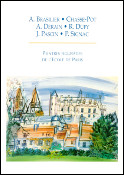
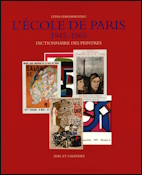
The New School of Paris refers to a tremendous artistic effervescence that, in the aftermath of World War II and until the mid-1970s, restored the French capital's status as a global cultural crossroads. Unlike the early-century historical school, which brought together foreign figurative artists, this "new" generation was characterized by a radical exploration of abstraction, whether lyrical, geometric, or informal. Driven by the desire to rebuild a world in ruins through an unprecedented visual language, painters and sculptors from diverse backgrounds converged on the Saint-Germain-des-Prés and Montparnasse districts. This informal movement was marked by major figures such as Jean BAZAINE, Alfred MANESSIER, Maurice ESTÈVE, Serge POLIAKOFF, Maria Helena VIEIRA da SILVA, or even Pierre SOULAGES, who all contributed to redefining pictorial modernity.
At the heart of this New School of Paris's approach lay an intense aesthetic debate between two visions of abstraction, often unified during foundational collective exhibitions. On one side, the rigorous geometric abstraction advocated by artists like Victor VASARELY stood opposed to the lyrical abstraction or "abstract landscapism" of Jean FAUTRIER, Georges MATHIEU, or Hans HARTUNG, who favored pure emotion, spontaneous gesture, and matter. This effervescence materialized during key events, notably the first editions of the Salon des Réalités Nouvelles created as early as 1946, or the famous "Véhémences confrontées" (Confronted Vehemences) exhibition organized in 1951 by critic Michel Tapié at the Nina Dausset gallery, which established informal art against the emerging American art scene.
The collective and its gallery networks also played a decisive role in the dissemination and recognition of these artists, transforming Paris into a laboratory for memorable exhibitions. Annual salons, such as the Salon de Mai founded in 1945, as well as the actions of visionary gallerists like Denise René, Jeanne Bucher, or Louis Carré, became the epicenters of this avant-garde. It was within this context that artists with singular trajectories like ZAO Wou-Ki, Nicolas de STAËL, or Bram van VELDE were able to confront their investigations into light, space, and color, proving that Paris remained an essential stepping stone for international visual experimentation.
Today, the 1954-1975 period of the New School of Paris is recognized as the swan song of Parisian artistic supremacy before the art market shifted toward New York. This pivotal period and the pinnacle of abstraction have been the subject of major historical re-evaluations, much like the flagship exhibition "L'Envolée lyrique, Paris 1945-1956" at the Musée du Luxembourg in 2006, or the major monographic retrospectives dedicated to its masters at the Centre Pompidou. By combining the freedom of gesture with a profound spiritual and poetic demand, this generation of artists left a lasting legacy that bears witness to an unwavering faith in the power of painting to transcend reality, continuing to fascinate collectors worldwide.