 themes : ZERO Group (1957-1967) themes : ZERO Group (1957-1967)
|
 |
Bernard AUBERTIN (France, Fontenay-aux-Roses 1934 - Germany, Reutlingen 2015)
Enrico CASTELLANI (Italy, Castelmassa 1930 - Viterbo 2017)
Heinz MACK (Germany, Lollar 1931)
Piero MANZONI (Italy, Soncino 1933 - Milan 1963)
Henk PEETERS (Netherlands, The Hague 1925 - Hall 2013)
Otto PIENE (Germany, Laasphe 1928 - Berlin 2014)
Jan SCHOONHOVEN (Netherlands, Delft 1914 - 1994)
Günther UECKER (Germany, Wendorf 1930)
Jef VERHEYEN (Belgium, Itegem 1932 - France, Gordes 1984)
|
|
| |

[ZERO GROUP]
ZERO
Ostfildern, Hatje Cantz Verlag, 2006. |
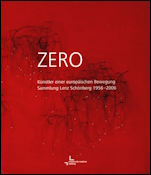
[ZERO GROUP]
ZERO
Salzburg, Museum der Moderne, 2006. |
|
|
|
| |
|
|
|
| |
|


The ZERO group was founded in 1957 in Düsseldorf by HEINZ MACK and OTTO PIENE, who were joined in 1961 by GÜNTHER UECKER. Born as a reaction against the psychological heaviness of Abstract Expressionism and post-war Art Informel, the movement conceived itself as a zone of silence and purity, a ground zero from which everything becomes possible. This avant-garde collective sought to open up a new artistic perspective freed from the subjectiveness of the artist, turning instead toward the future, science, and technological optimism.
The aesthetic of ZERO is characterized by the exploration of light, movement, space, and monochrome structure, with an absolute preference for the color white. Artists abandoned traditional brushes to use industrial materials and innovative techniques, such as the nail reliefs of GÜNTHER UECKER, the rotating aluminum structures of HEINZ MACK, or the fire paintings of French artist BERNARD AUBERTIN. Rhythm, seriality, and the participation of natural forces like wind or fire transformed the artwork into a dynamic device in constant evolution.
The movement quickly acquired an international dimension by forging close ties with other European artists who shared the same radical vision, notably PIERO MANZONI and ENRICO CASTELLANI in Italy, JEF VERHEYEN in Belgium, as well as JAN SCHOONHOVEN and HENK PEETERS from the Nul group in the Netherlands. The year 1962 marked a major historical milestone with the organization of the group exhibition Zero at the Stedelijk Museum in Amsterdam. This event sealed the cohesion of this transnational network and formalized the impact of their spatial and kinetic research on a European scale.
The group chose to officially disband in 1966 during a final festive exhibition in Bonn, believing that ZERO had accomplished its mission and that its members should now pursue their individual paths. Although its active existence lasted only a decade, the legacy of ZERO remains foundational in the history of contemporary art. By redefining the relationship between the work, the environment, and the viewer, the movement directly paved the way for Kinetic Art, Minimal Art, and the earliest forms of immersive installations.