|
 |
BOREMANS Guillaume (Belgium, Antwerp 1883-1954)
CARLO (Carlo Zinelli) (Italy, 1916 - 1974)
CHAISSAC Gaston (France, Avallon 1910 - La Roche/Yon 1964)
FACTEUR CHEVAL (Ferdinand Cheval) (France, 1836-1924)
ALOÏSE (Aloïse Corbaz) (Switzerland, 1886-1964)
CREPIN Fleury Joseph (France, Hénin-Liétard 1875 - 1948)
DARGER Henry (United States, Chicago 1892-1973)
DUBUFFET Jean (France, Le Havre 1901 - Paris 1985)
FORESTIER Auguste (France, Lozère 1887 - Saint-Alban 1958)
GILL Madge (United Kingdom, Walthamstow 1882 - London 1961)
LIGABUE Antonio (Switzerland, Zurich 1899 - Italy, Gualtieri 1965)
LONGECHAL Jean-Joseph (France, Allier 1909 - 1980)
|
MAISONEUVE Pascal-Désir (France, Bordeaux 1863-1934)
PODESTÀ Giovanni Battista (Italy, Laveno Mombello 1895-1976)
RAMIREZ Martín (Mexico, Jalisco 1895 - United States, Auburn 1963)
ROBLES Laure (Spain, El Chorro 1892 - France, Mende 1967)
SANFOURCHE Jean-Joseph (France, Bordeaux 1929 - 2010)
SCOTTIE WILSON (Louis Freeman) (United Kingdom, 1888 - 1972)
SOUTTER Louis (Switzerland, Morges 1871 - Ballaigues 1942)
TANDATU Raymond (Congo, 1944-2012)
WÖLFLI Adolf (Switzerland, Bowil 1864 - Bern 1930)
YAKICHA (Yakovlevitch) (Ukraine, 1894 - France, 1955)
ZEMANKOVA Anna (Czech Republic, 1908 - 1986)
etc...
|
|
| |
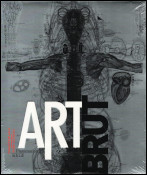
[COLLECTIONS].
Art brut : Collection abcd.
Paris, Editions Flammarion, 2014. |
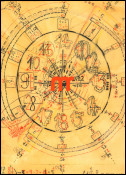
[COLLECTIONS].
Art brut : Collection abcd.
Paris, Fage / La maison rouge, 2014. |
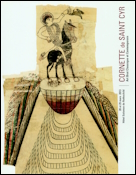
[ART BRUT].
Classical and Contemporary Art Brut.
Paris, Cornette de Saint Cyr, 2013. |
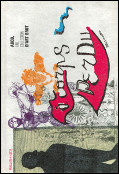
[COLLECTIONS].
ABCD, An Art Brut Collection.
Paris Musées, 2004. |
|
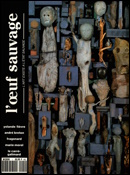
[COLLECTIVE].
L'Oeuf sauvage.
Paris, Editions Pleine Marge, 1991-92. |
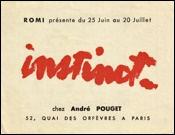
[COLLECTIVE].
Instinct.
Paris, Romi / André Pouget, 1956. |
|
|
|
| |
|
|
|
| |
|


ART BRUT (Outsider Art) takes its roots in early 20th-century psychiatric research, but it was in 1945 that the French artist Jean DUBUFFET conceptualized and theorized the term. During a trip to Switzerland that year, marked by visits to psychiatric hospitals and prisons in the company of writer Jean Paulhan, DUBUFFET became fascinated by graphic and plastic productions created completely outside traditional cultural networks. In 1947, he founded the Foyer de l'Art Brut in Paris, which one year later became the Compagnie de l'Art Brut, an associative entity (including members like André Breton) dedicated to collecting these marginal works. It was within this emerging circle that the Vendée-born artist Gaston CHAISSAC was integrated as early as 1948. This self-taught creator, who used industrial paint on salvaged objects (tree stumps, cardboard), perfectly embodied the freedom of expression sought by Dubuffet, even though Chaissac's own quest for cultural recognition would later lead the theorist to reclassify his work into an adjacent category, highlighting the complex boundaries of this art form.
At the heart of ART BRUT lies the absolute rejection of artistic conventions, trends, and academic institutions. DUBUFFET defined it as productions executed by individuals untainted by artistic culture, who draw everything from their own resources. The creators — whether institutionalized, marginalized, reclusive, or mediums — create out of an absolute inner necessity, with no concern for the gaze of the public or the art market. To document and disseminate this underground aesthetic without relying on official channels, the Compagnie de l'Art Brut launched its own journal in 1964: the Fascicules de l'Art Brut. Edited by DUBUFFET, this scientific and militant publication became the movement's theoretical weapon, publishing detailed monographs on discovered creators to prove that a pure creative impulse exists outside of museums.
In terms of techniques and materials, ART BRUT is characterized by total freedom and an ingenuity dictated by isolation or a lack of means. Rejecting canvas and classical tools, these artists use makeshift supports such as debris, packaging, or walls, and sometimes manufacture their own pigments from soot or plant juices. Their works often manifest as an obsessional accumulation of details, distorted perspectives, or invented alphabets. These productions bear witness to a total reinvention of visual codes, unique to the specific mental universe of each creator, far removed from any academic mimicry.
The recognition of ART BRUT was definitively consolidated through major collections and its profound influence on contemporary creation. The key moment of this public recognition occurred in 1971 when Jean DUBUFFET donated his personal collection to the city of Lausanne in Switzerland, leading to the official opening of the Collection de l'Art Brut in 1976. It was also in Lausanne, beginning in 1977, that the publication of the Fascicules de l'Art Brut continued under the direction of Michel Thévoz. Iconic figures such as Aloïse CORBAZ, Adolf WÖLFLI, Henry DARGER, or the FACTEUR CHEVAL with his Ideal Palace (completed in 1912) are today celebrated internationally. This heritage deeply transformed our perception of creativity, paving the way for other derived concepts such as Outsider Art or Art Singulier.
To understand how ART BRUT established itself within the cultural landscape, several major exhibitions served as historical milestones. Here are the main stages:
"L'Art Brut préféré aux arts culturels" (1949 – Galerie René Drouin, Paris)
This is the founding exhibition of the movement. Jean DUBUFFET presents the fruits of his underground collections to the general public for the very first time: 200 works by 63 creators (including Aloïse CORBAZ and Adolf WÖLFLI). The provocative title of the exhibition, accompanied by a treatise written by DUBUFFET, hit like a manifesto of war against bourgeois academicism.
The exhibition of the Collection de l'Art Brut (1967 – Musée des Arts Décoratifs, Paris)
Eighteen years later, DUBUFFET made a major impact by installing ART BRUT at the heart of a prestigious institution. This immense retrospective brought together over 700 works from his personal collection. The exhibition caused an immense visual and critical shock, definitively forcing the art world to view these marginal productions as fully-fledged masterpieces.
The inauguration of the Collection de l'Art Brut (1976 – Château de Beaulieu, Lausanne)
Although a permanent opening, this event marks the definitive display of the historical core of ART BRUT. Following DUBUFFET's donation to Switzerland, the public discovers on a permanent and museum-scale basis the great bodies of work by Henry DARGER, Scottie WILSON, or the FACTEUR CHEVAL, permanently enshrinining the movement.
"L'Art Brut : de l'ombre à la lumière" (1982 – Aulnay-sous-Bois)
This exhibition marked an important media turning point in France following the gradual passing of the initial avant-garde. It paved the way for the recognition of other private collections and the emergence of new concepts like Art Singulier, proving that "raw" creation continued to thrive outside DUBUFFET's historical circle.
The consecration of the Bruno Decharme Donation (2025/2026 – Grand Palais / Centre Pompidou, Paris)
A symbol of Art Brut's definitive entry into the greatest national museums of the 21st century, this event highlights hundreds of works from one of the world's largest private collections (the abcd collection). It demonstrates the extent to which ART BRUT is now considered a major and essential component of global art history.